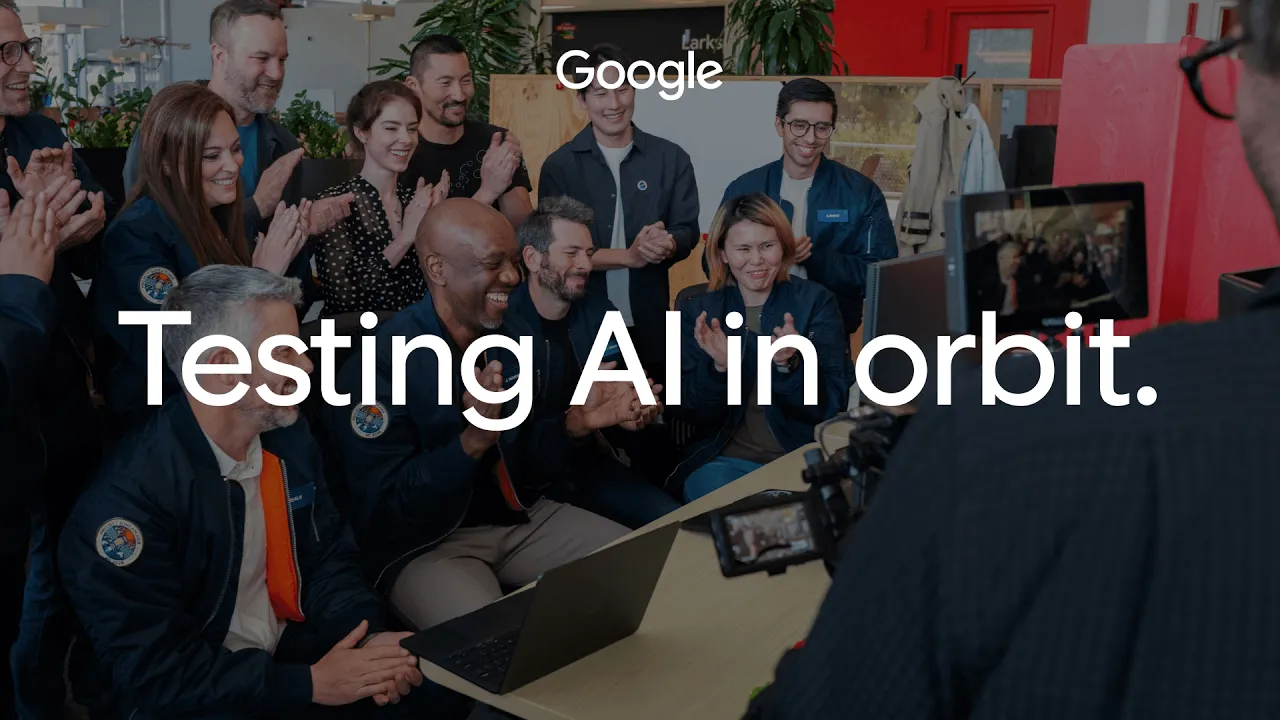
Google's AI-equipped satellite, part of the experimental Project Suncatcher initiative, has successfully transmitted its first response from orbit. The satellite's Tensor Processing Units (TPUs) were activated, allowing the onboard Gemma 4 model, developed by Google DeepMind, to process a prompt and generate a haiku about being in space. This achievement demonstrates the potential for running AI workloads in the challenging environment of space.
This successful transmission is a significant milestone for Google's ambition to establish data centers in space. The company plans to conduct further tests to evaluate the performance of the TPUs under thermal stress and radiation exposure in orbit. These findings will be crucial for verifying the reliability of their hardware in space and paving the way for future, more advanced missions.
Why it matters
This experiment is vital for understanding how AI hardware functions under space conditions. The TPUs aboard the satellite will experience real-world space radiation, offering invaluable data on their long-term durability, which differs significantly from Earth-based testing in particle accelerators. If successful, this technology could dramatically enhance space-based computing and analytical capabilities, opening new avenues for scientific research, communication networks, and beyond.
What it means for you
Currently, Google's Project Suncatcher has no direct impact on users in your region. The project is primarily a long-term investment in Google's space and AI infrastructure. However, advancements in this field could create future opportunities for collaboration with local tech companies and researchers. Enabling AI models to operate in space could lead to faster processing and analysis of satellite data, potentially benefiting your country's space and technology sectors. Future phases might involve partnerships with universities or research institutions.
Next Steps
Following these initial tests, Google will thoroughly analyze the TPUs' performance in space, with a particular focus on the effects of radiation. Based on this data, Google intends to launch two more advanced satellites in 2027. These future spacecraft are designed to support higher power generation and establish inter-satellite optical links, aiming to create a network capable of handling distributed workloads in orbit. The ultimate goal of Project Suncatcher is to establish economically viable space data centers by the 2030s.
Technical Details
The Project Suncatcher satellite is equipped with four Google Tensor Processing Units (TPUs), though only one can operate at a time due to power constraints, generating up to approximately 1 kW of electricity. This limitation complicates space-to-ground communications. After a three-week commissioning phase testing its subsystems, the spacecraft was ready for its first operational prompt. The Gemma 4 model, pre-loaded onto the satellite, then generated a haiku about its experience in space.
Frequently Asked Questions
Q: What did Google's AI satellite in space do?
A: Google's Project Suncatcher satellite transmitted its first response from space, successfully running the Gemma 4 AI model and composing a space-themed haiku.
Q: When did this project begin?
A: Google launched the Project Suncatcher satellite into orbit earlier this month on a SpaceX Falcon 9 rocket.
Sources:TechCrunch,The Verge
This story was compiled from the reporting of the sources above with AI assistance. Our editorial policy
From Weras Labs
We can help you with this
We turn what you just read into working software for your business. You talk to the person writing the code; price and timeline are clear from day one.
Frequently asked questions
What did Google's AI satellite in space do?
Google's Project Suncatcher satellite transmitted its first response from space, successfully running the Gemma 4 AI model and composing a space-themed haiku.
When did this project begin?
Google launched the Project Suncatcher satellite into orbit earlier this month on a SpaceX Falcon 9 rocket.
About the author

Habip Dayan
Founder of Weras Labs
Habip Dayan is the founder of Weras Labs, a company that builds software products for professionals and teams. He has been building software since 2018 and writes about AI, cloud architecture and product design.
Comments
Be respectful; no ads or personal data. Comments that break the rules are removed.